
Two Lectures, One Shawl, and a Lifetime of Belonging: A Day with the Jaipur Orthopaedic Society
There are conferences you attend, and there are conferences you carry home with you. Today in Jaipur was firmly the second kind.
The Jaipur Orthopaedic Society organised a focused symposium on shoulder trauma, and I had the privilege of delivering two guest lectures to a hall full of surgeons who came with questions sharper than any I had prepared for.
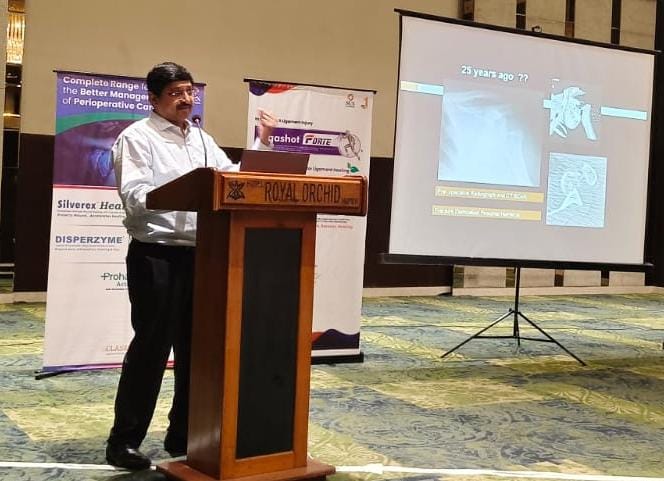
Lecture One: Current Management Guidelines for Proximal Humerus Fractures — An Overview
The proximal humerus fracture remains one of the most argued-about injuries in our specialty, and for good reason. It is common, it is heterogeneous, and the literature has spent the last fifteen years quietly dismantling assumptions many of us trained on.
The themes I tried to bring out:
Not every fracture needs a plate. A large proportion of these injuries — minimally displaced, stable, in a compliant patient — do very well with well-supervised non-operative care and early motion. The results of the PROFHER trial and the studies that followed have permanently shifted where the burden of proof sits.
Classification should guide thinking, not replace it. Neer and AO give us a shared language, but the decision is made on the patient in front of you: bone quality, head-shaft alignment, medial calcar integrity, tuberosity position, and above all the functional demand and biological age of the patient.
The medial calcar and the posteromedial hinge decide your fate. Where the calcar is comminuted and unsupported, varus collapse follows a locking plate with depressing regularity. Calcar screws, fibular strut augmentation, or a different plan altogether should be on the table before the incision, not after.
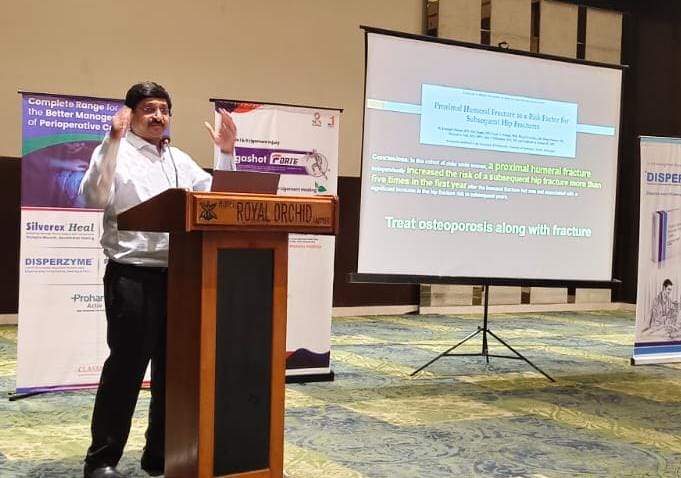
Fix the fracture, but also treat the patient. This is the point I made most forcefully, and the slide I left up longest: a proximal humerus fracture in an older adult is a sentinel event. The evidence that it multiplies the risk of a subsequent hip fracture — most sharply in that first year — is strong enough that discharging such a patient without addressing bone health is an incomplete operation. Treat osteoporosis along with the fracture.
Lecture Two: Replacement in Proximal Humerus Fractures — When and How
The second talk moved into the territory where judgment matters more than technique.
When?
Arthroplasty earns its place where fixation is likely to fail rather than where fixation is merely difficult — the head-split fracture, the severely osteoporotic four-part pattern, the anatomical neck fracture with a devascularised head, and the older patient in whom a long, protected rehabilitation is simply not realistic.
Which one?
The pendulum has swung firmly toward reverse shoulder arthroplasty in the elderly, and the reason is honest: hemiarthroplasty lives or dies by tuberosity healing, and in osteoporotic bone the tuberosities too often do not heal where we put them. The reverse gives a predictable floor of function that does not depend on that healing. In the younger patient with good bone and reconstructible tuberosities, hemiarthroplasty still has a legitimate role.
How?
The details that separate a good result from a mediocre one:
Restoring humeral height and version rather than trusting the fracture to tell you where they were
Meticulous tuberosity reduction, cerclage, and bone grafting behind the repair — even in a reverse, healed tuberosities buy you external rotation
Respecting the deltoid and the axillary nerve
A rehabilitation protocol written before surgery and shared with the patient
Being Felicitated — and Made a Life Member
After the academic session, the Society honoured me with a shawl and — a gesture that genuinely moved me — Lifetime Membership of the Jaipur Orthopaedic Society.
I want to say something about what that means, because it is easy to let these moments pass as ceremony.
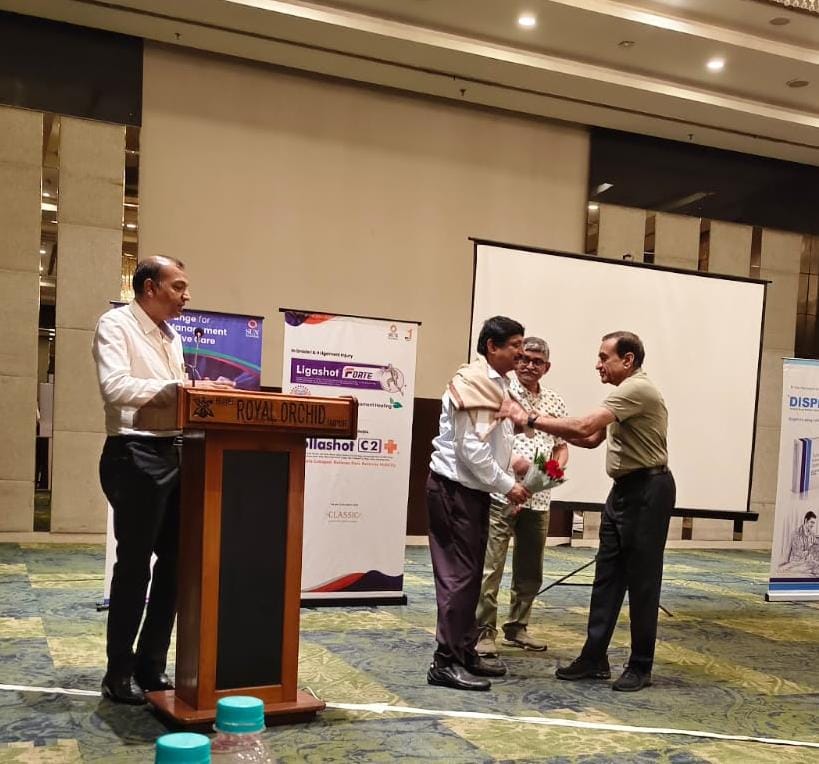
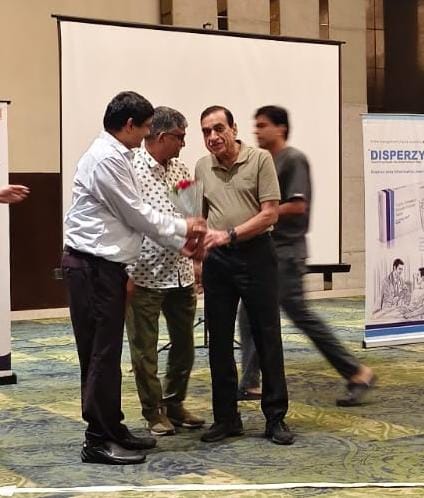
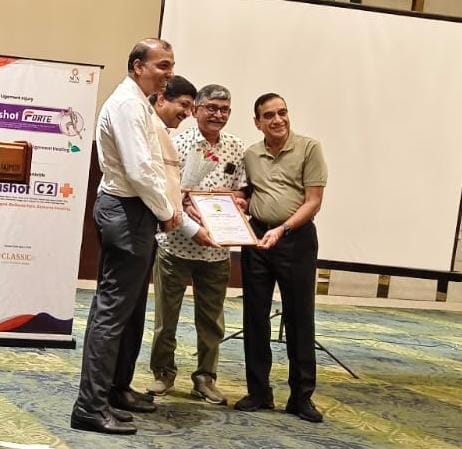
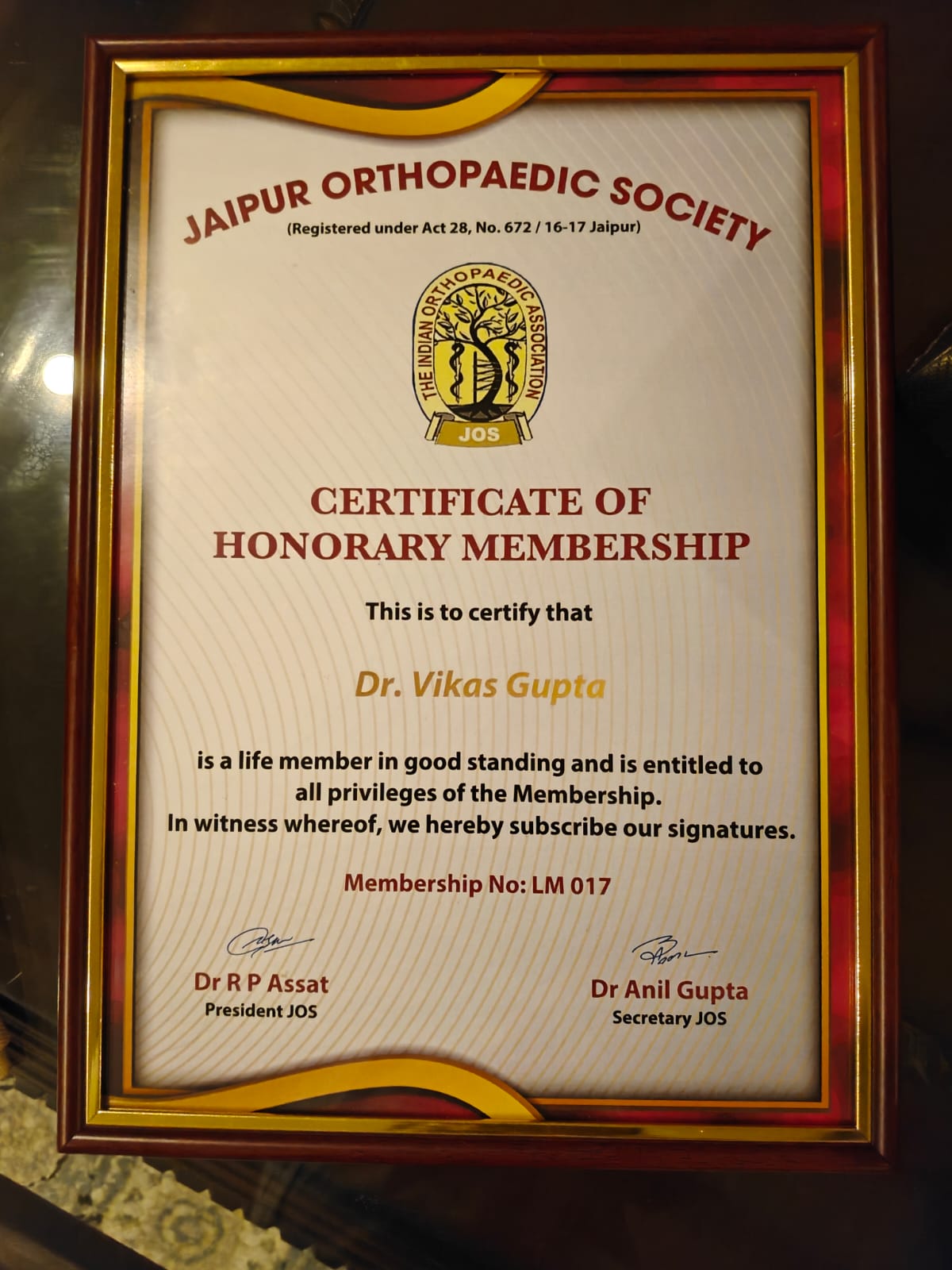
Academic societies are how a specialty transmits itself. Guidelines are written in journals, but they are absorbed in rooms like the one I stood in today — arguing over a radiograph, disagreeing about a calcar screw, admitting a case that did not go well. To be given permanent membership of such a community is not a medal for past work; it is an invitation to keep showing up.
To the office bearers and members of the Jaipur Orthopaedic Society: thank you. For the invitation, for the rigour of your questions, and for the warmth with which you received a visitor. Jaipur has a way of making a guest feel like a local, and today was no exception.