
Surgeon to Surgeon in Antwerp: Learning from Europe’s Shoulder Experience @Vikas Gupta · 11 Oct 2026 | Hand2Shoulder Clinic
https://www.hand2shoulderclinic.in/?p=7643
Some of the best surgical learning happens when you stand beside someone who has already seen what is coming. That was my reason for travelling to Antwerp from October 7 to 9, 2026, for a surgeon-to-surgeon (S2S) programme with Prof. Dr. Olivier Verborgt.

I went with three goals. I wanted to get familiar with shoulder implants that are about to be launched, to understand the problems Europe is already seeing years after revision arthroplasty, and to see first-hand the technology that is changing how shoulder replacements are planned and performed: robotics, 3D planning, and mixed and virtual reality.
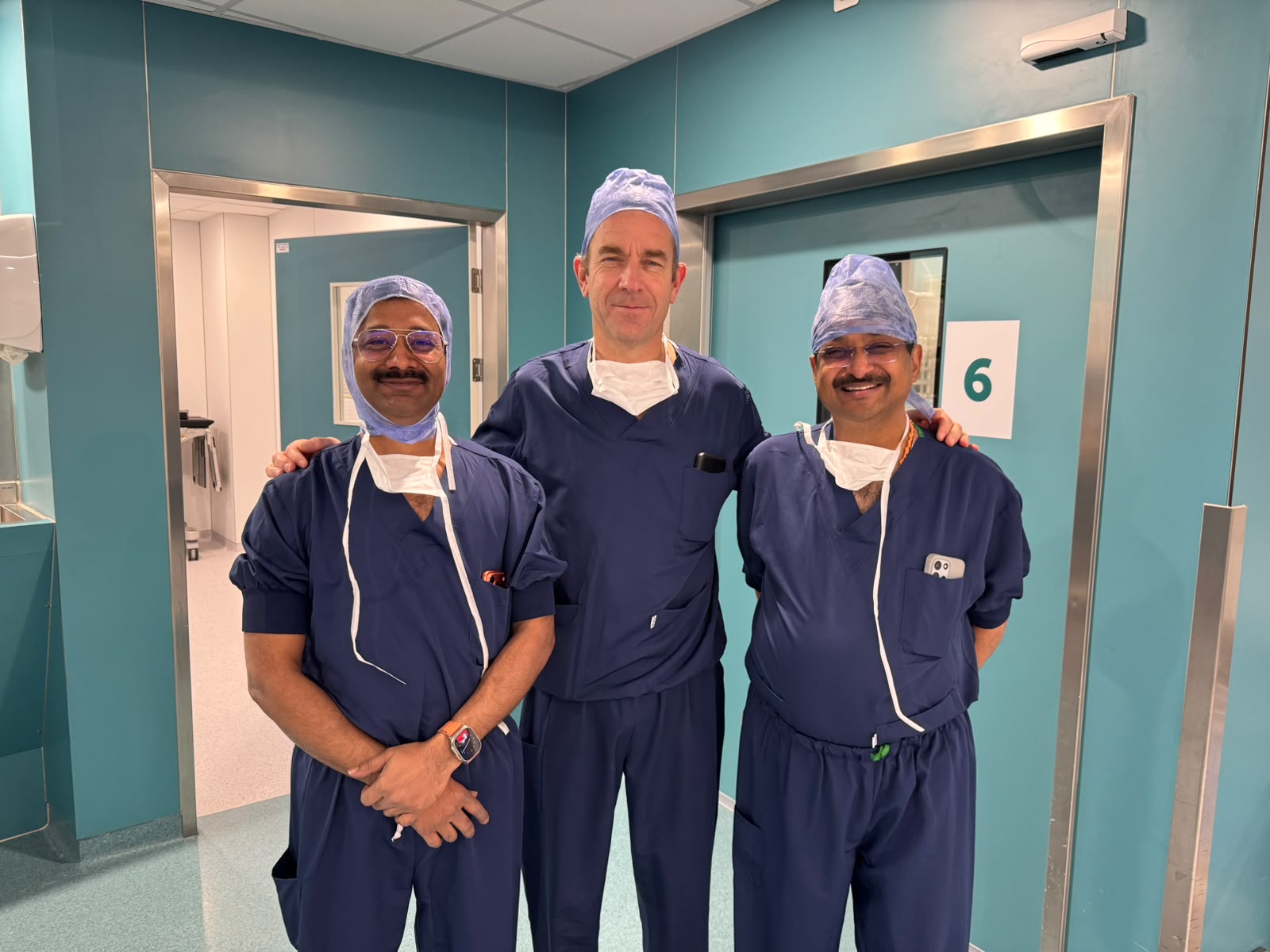
Three days, one cycle
S2S is built on direct exchange between peers, not lectures. Each day followed the same rhythm: a pre-case briefing and planning discussion, live cases in the operating theatre, and a post-case debrief where we compared decisions, technique and outcomes.
The cases grew more demanding as the days went on. Day 1 opened with a discussion on indications and patient selection, followed by a primary shoulder and a complex shoulder case. Day 2 repeated that pairing and added a session on technique for complex cases. Day 3 was devoted to a revision shoulder, and the programme closed with a presentation on the ROSA Shoulder robot and an open question-and-answer session.
What I valued most was that planning came first every time. Each case began with a conversation about why we were operating and how, not just what we would do.
Europe’s head start on revisions
European surgeons began reverse shoulder arthroplasty about 40 years ago but became popular in late 1990’s. In India, it became popular after 2010. That difference matters, because the problems Europe is seeing today, in the late and long-term follow-up of reverse shoulder arthroplasty (RSA) cases, are likely to be the problems we meet in the years ahead.
Revision of earlier reverse shoulder arthroplasty has become common there. Seeing these cases in theatre, and discussing planning, intra-operative decisions and long-term results with a surgeon who handles them at scale, is a rare opportunity. It lets us prepare, rather than learn each lesson the hard way, one patient at a time.
The Day 3 revision case, with its planning briefing and debrief, was the clearest example of this for me.
Implants worth watching: Identity and OsseoFit
The second thing I wanted from this visit was early familiarity with implants that will soon reach our operating rooms. Two stood out: the Identity Shoulder System and the OsseoFit stemless system, both from Zimmer Biomet.
Identity is built around humeral heads with Versa-Dial technology, which allows infinite offset placement. OsseoFit is a stemless anatomic implant with left- and right-specific anchors shaped to match the natural humerus. Its fins give a press-fit on insertion, and porous metal windows allow biological fixation. It works with Identity heads and the Alliance glenoid, has anterior suture holes for anatomical reattachment of the subscapularis, and comes in a single instrument tray.
The stemless idea connects directly to revision surgery. Surgeons involved in OsseoFit’s development point out that as younger, more active patients receive shoulder replacements, preserving bone leaves more room for a future revision. After seeing what revision demands in Antwerp, that argument carries real weight.
OsseoFit received US FDA clearance in December 2024, with a US launch planned for early 2025. Launch dates for India have not been confirmed.
From CT to robot: Signature ONE and ROSA Shoulder
Every session in Antwerp began with planning, and the software behind it was Signature ONE. Planning starts from a CT scan. Zimmer Biomet returns an initial plan that combines the surgeon’s preferences with the patient’s anatomical landmarks, and the surgeon adjusts it. The plan covers humeral height, version and inclination as well as glenoid placement. It can also be used to make patient-specific 3D-printed guides and bone models, with a glenoid guide that helps place the first pin without adding steps to the operation. The sessions I saw were labelled Pure Planning.
That same plan feeds the robot. ROSA Shoulder, which closed the programme, is described by its manufacturer as the world’s first robotic system for shoulder replacement, cleared by the US FDA for both anatomic and reverse techniques. The first robotic-assisted shoulder replacement was performed at Mayo Clinic in April 2024.
For a shoulder surgeon, a few features stand out. The robot can reproduce the planned humeral head resection, and it removes the need for a central glenoid pin. It gives real-time data during surgery to execute and check the Signature ONE plan. It supports the Comprehensive, Identity and Alliance systems, and it allows a switch to a reverse shoulder during the operation if needed.
The workflow is becoming a chain: CT, plan, then robot-guided execution with the chosen implant. It is early days, though. Most accuracy claims so far come from the manufacturer, and I will be watching for independent, long-term outcome data before judging its true value.
Mixed and virtual reality
The visit also showed me that mixed and virtual reality are moving into shoulder replacement, alongside robotics and 3D planning. These tools are still emerging. I want to understand them early, so that I can tell where they genuinely help in planning, in guiding surgery and in training, and where they are novelty.
What I am taking back to my patients
Three things come home with me. First, better preparation for the complications and revision scenarios that can follow primary arthroplasty. Second, early familiarity with new implants and technology, which makes adopting them safer. Third, sharper patient selection, informed by Europe’s longer experience with revisions.
Shoulder arthroplasty is changing quickly, and learning from surgeons further along the revision curve is one of the best ways to keep our practice current. I am grateful to Prof. Verborgt and his team for their openness and generosity.
About the author
Dr. Vikas Gupta is Principal Director of the Division of Hand to Shoulder Surgery at Max Smart Super Speciality Hospital, Saket, New Delhi, and founder of Hand2Shoulder Clinic in Greater Kailash. He also practises at Max Hospital Gurgaon and runs an Upper Extremity Surgery Fellowship programme at Max Hospital.
This post is for professional and general information and is not medical advice for any individual patient.
Sources
Product details are as published by the manufacturer and trade press. Indian launch dates are not confirmed.
- OsseoFit Stemless Shoulder System, Zimmer Biomet
- Zimmer Biomet secures FDA approval for OsseoFit, Medical Device Developments
- ROSA Shoulder System, Zimmer Biomet
- World’s first robotic surgery system for shoulder replacement, Med-Tech News
- First surgery with ROSA Shoulder, BoneZone
- Signature ONE Surgical Planning, Zimmer Biomet
- Signature ONE System FDA listing