
When Injections Fail: Tennis Elbow Surgery That Finally Ended a Year of Pain
A 45-year-old man’s journey from gym enthusiasm to chronic elbow pain — and the ECRB debridement surgery that gave him his arm back

A New Fitness Journey That Took a Wrong Turn
At 45, he decided it was time to get fit. He joined a gym, trained sincerely, and made real progress — until a nagging pain appeared on the outer side of his right elbow.
At first, it only hurt after workouts. Then it started hurting during them. Soon, everyday actions became difficult: lifting a kettle, turning a doorknob, shaking hands, even holding a cup of tea. Gripping anything with the elbow straight sent a sharp, burning pain down his forearm.
The diagnosis was tennis elbow (lateral epicondylitis) — and no, you don’t need to play tennis to get it. In fact, in our practice, gym-goers, homemakers, and desk workers far outnumber tennis players.
What Exactly Is Tennis Elbow?
Tennis elbow is not a simple “inflammation.” It is a degenerative condition of the ECRB tendon (extensor carpi radialis brevis) — the tendon on the outer elbow that anchors the muscles which lift the wrist and stabilise the grip.
Repetitive loading — like gripping dumbbells with poor wrist position, or a sudden jump in training intensity — causes microtears in the ECRB tendon at its attachment. Instead of healing, the tendon develops disorganised, unhealthy tissue (what we call angiofibroblastic degeneration). This diseased tissue is the true source of the pain.

One Full Year of Trying Everything Else
Like most patients, he started — correctly — with conservative treatment:
Months 1–2: Physiotherapy and medication. Stretching, strengthening, activity modification, and anti-inflammatory medicines (NSAIDs). The pain would settle briefly, then return with any loading.
Next: A local steroid injection. This gave short-term relief, as steroids often do — but within weeks, the pain crept back. Steroid injections can calm symptoms temporarily, but they do not repair the diseased tendon, and repeated injections can actually weaken it.
Four months before surgery: A PRP (platelet-rich plasma) injection. PRP helps a subset of patients by stimulating a healing response. In his case, despite adequate time and proper rehabilitation, the pain persisted.
A full year had passed. He was no longer just missing the gym — his sleep, work, and daily life were affected.
This is the point at which surgery enters the conversation: when 6–12 months of well-conducted conservative treatment, including injections, has failed.
The Decision at Hand2Shoulder Clinic
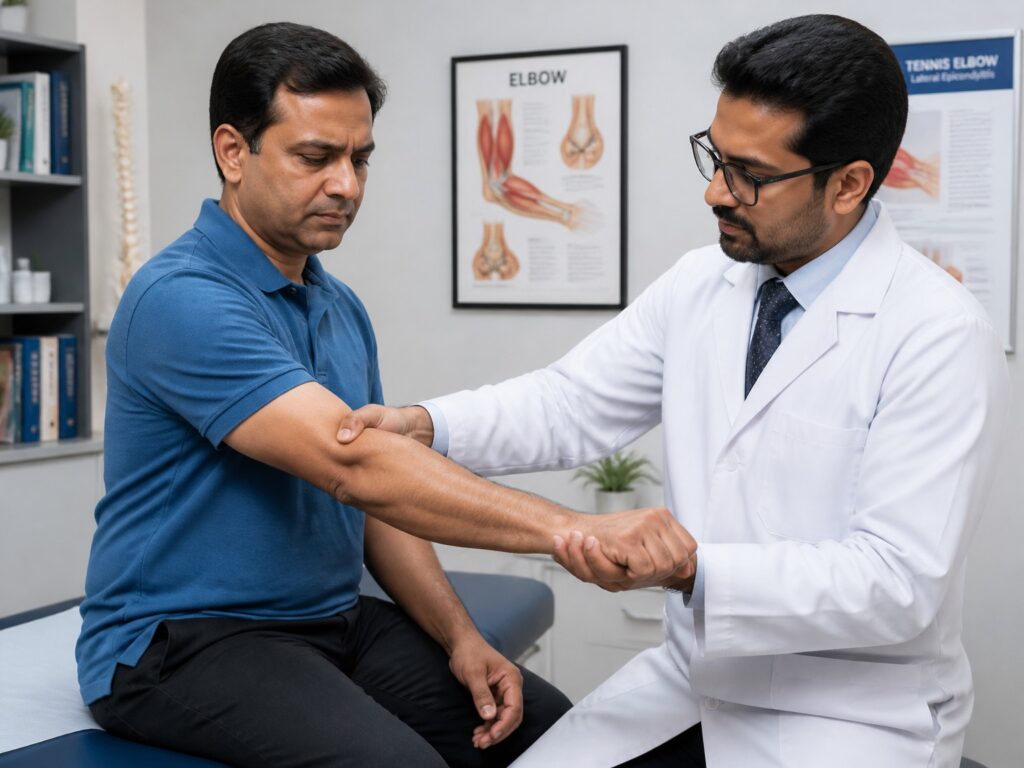
When he attended Hand2Shoulder Clinic, Dr. Vikas Gupta reviewed his entire treatment journey, examined the elbow, and assessed his imaging. The findings were consistent: a chronic, treatment-resistant lateral epicondylitis with degeneration of the ECRB origin.
The recommendation was clear — surgical debridement and release of the ECRB tendon. The goal of this surgery is simple and logical: remove the diseased tendon tissue that will never heal on its own, release the tension at the tendon origin, and allow healthy tissue to take over.
The Surgery: ECRB Debridement and Release
Through a small incision over the outer elbow, the ECRB tendon was identified and carefully inspected. The degenerated, greyish, unhealthy tissue — quite distinct from normal, pearly-white tendon — was meticulously excised. The tendon origin was released and the bony surface freshened to stimulate a healing response, while carefully preserving the important lateral ligament complex that keeps the elbow stable.
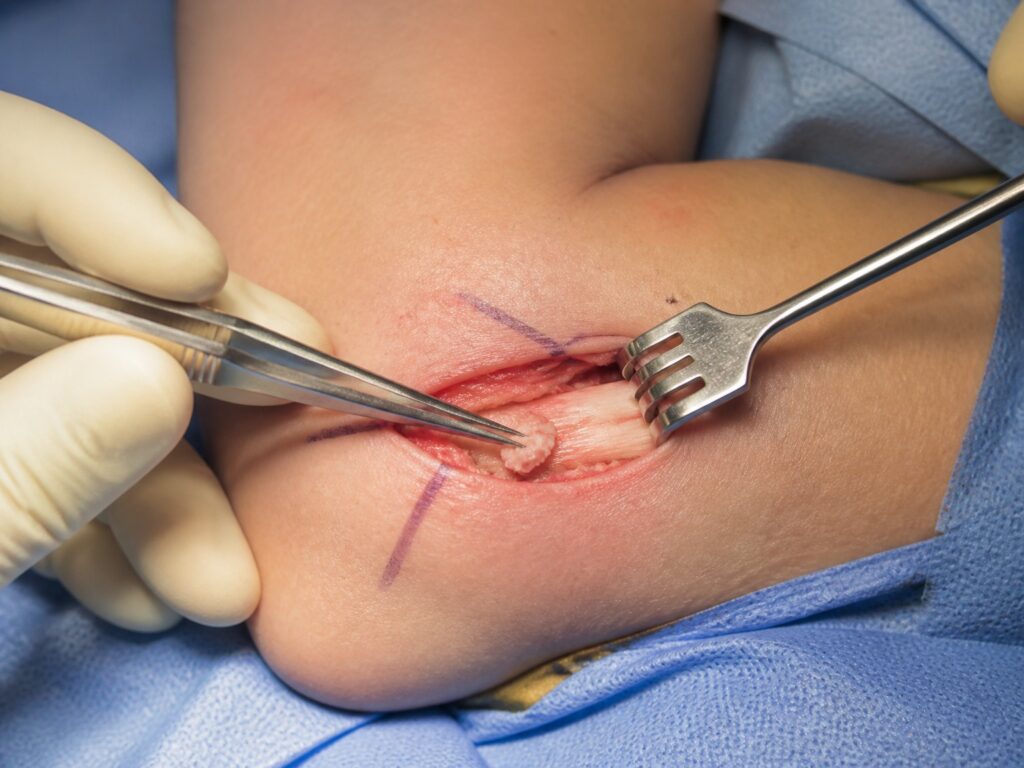
The procedure is a day-care surgery — he went home the same evening with the elbow in a comfortable dressing.
Recovery: Where Rehabilitation Makes All the Difference
Surgery removes the diseased tissue — but structured rehabilitation is what rebuilds a pain-free, working arm. His recovery followed our protocol using arthrokinetic therapy, a movement-based rehabilitation approach that restores normal joint mechanics, muscle activation, and load tolerance in a graded, pain-guided manner.
Weeks 1–3: Wound healing, gentle wrist and elbow mobilisation, and early arthrokinetic therapy sessions. By the end of week 3, his pain had significantly reduced — the deep, burning ache that had troubled him for a year was gone.
Weeks 3–6: Progressive stretching and controlled strengthening of the forearm muscles, with correction of the wrist and grip mechanics that had contributed to the problem in the first place.
Weeks 6–10: Graduated loading and functional training. By 10 weeks, he was performing light gym exercises without pain — a milestone that had seemed impossible a few months earlier.


The Takeaway
Tennis elbow deserves patience — most cases settle with good physiotherapy and time. But when pain persists beyond 6–12 months despite physiotherapy, NSAIDs, steroid injection, and PRP, continuing to repeat the same treatments rarely changes the outcome. The diseased ECRB tissue simply cannot heal itself.
For the right patient, ECRB debridement and release is a small surgery with a big impact — and when paired with structured rehabilitation like arthrokinetic therapy, the results are both faster and more durable.
If your elbow pain has crossed the six-month mark despite proper treatment, it may be time for a specialist opinion.